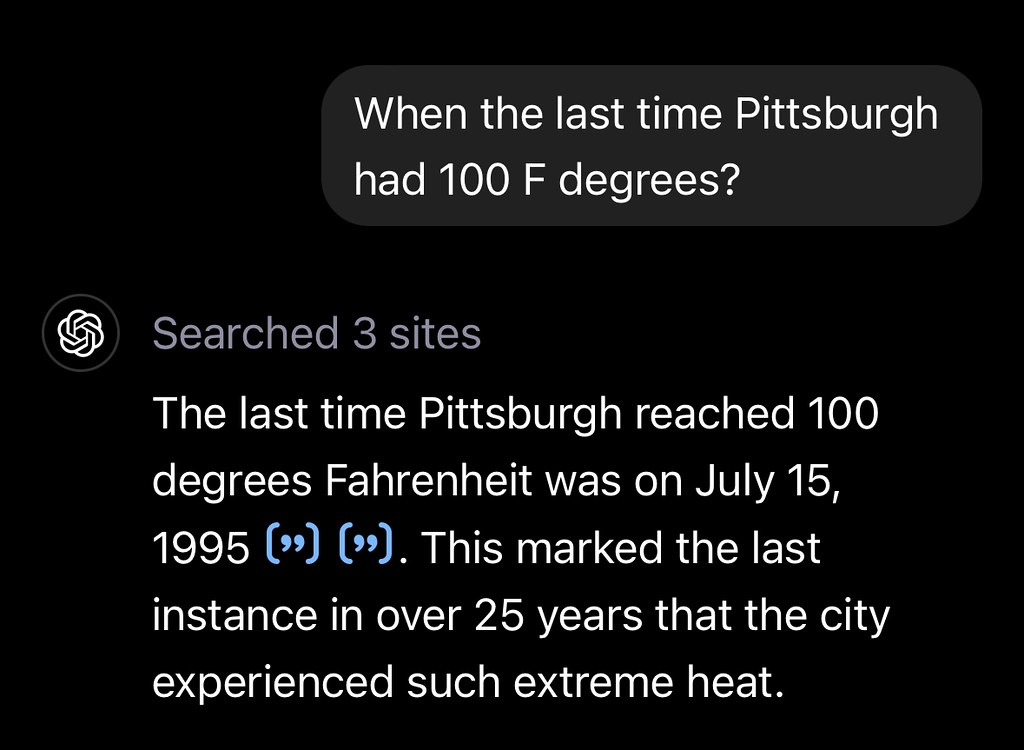
Here is SEO vs GEO vs AEO in the short version, so you can get on with your day. SEO is the work of earning a click out of a list of links. AEO (Answer Engine Optimization) is the work of being the answer displayed at the top — the snippet, the voice reply, the box that means nobody scrolls. GEO (Generative Engine Optimization) is the work of being one of the sources ChatGPT, Perplexity or Google’s AI Overview draws on when it writes an answer in its own words.
Now the useful part, which most explainers of SEO vs GEO vs AEO leave out: sit down and list the actual tasks behind each one and they overlap heavily. Three destinations, largely one road. If you run a fifteen-person business, one plan with a second scoreboard bolted on will cover you. The rest of this piece shows you where the road genuinely forks, where it doesn’t, and what that means for what you spend.
First: GEO has nothing to do with geography
Worth clearing up, because the abbreviation is bad. GEO here means Generative Engine Optimization. Nothing to do with maps, “near me” results or ranking in your city. That’s local SEO, a separate discipline with an unfortunately similar name.
The term comes from an academic paper, not a marketing deck. Aggarwal and colleagues named it in a paper accepted to KDD 2024, and their framing is the useful bit: generative engines are a problem for anyone who publishes, because creators have “little to no control over when and how their content is displayed” (GEO: Generative Engine Optimization, arXiv 2311.09735, accepted to KDD 2024).
Their headline result is a visibility boost of up to 40%. It’s up to, and it comes from a 10,000-query benchmark the authors built themselves called GEO-bench, run against an engine they assembled for the experiment. They also tried it on Perplexity.ai across 200 queries, where the same tactics scored 37% on one of their two visibility measures and 9% on the other. The paper says plainly that results vary by subject area, and the preprint went up in November 2023, which in this field is ancient. Useful direction of travel; no forecast for your business.
What each one is actually asking for
SEO: earning the click
The classic. Pages that load fast, a structure Google’s software can read end to end, content that matches what someone typed, other sites linking to you because you’re worth linking to. None of it has been deprecated. If your site is slow, thin and invisible, no AI-era tactic rescues it: every generative engine still draws most of its raw material from the same crawled web.
AEO: winning the box at the top
AEO grew out of voice assistants and featured snippets, those grey boxes that answer your question before the results start. The ask is structural: answer the question directly, near the top, in plain language, in a chunk a machine can lift cleanly. A page that meanders for 400 words before defining the thing in its own headline will lose to a page that defines it in sentence two.
There’s an awkward trade-off here. Winning can cost you the visit. If someone’s entire question is “what time does your store close,” being the answer means they never arrive. Fine, that visit was worth nothing anyway. But don’t optimize your highest-intent sales pages into tidy little answer boxes that satisfy people out of ever contacting you.
The answer-first habit behind AEO
Here is the single formatting move that does most of the work: lead with the answer, explain afterwards. Write the definition or the number in the first sentence under each heading, then spend the rest of the section earning trust. A machine lifts that first sentence cleanly; a human skimming gets what they came for without hunting. This “answer first” discipline is what separates a page that wins the box from one that buries the point three paragraphs down. It costs nothing but attention, and it serves readers and engines at the same time — which is rare in this work.
Question-based pages: how people really ask
People do not type into an AI tool the way they type into a search bar. They ask full, question-based sentences — “which of these should I prioritize for a new site?” — rather than two keywords. That matters for how you write. Group your content around the real questions a customer asks out loud, use those questions as your headings word for word, and answer each one before you elaborate. One of every five users worldwide already searched by voice in 2024, which pushes queries further toward natural, spoken phrasing (DemandSage estimate, reported 2025). A page built around questions reads better to a person and lifts more cleanly into an answer.
GEO: getting named by the model
The newest of the three, and the least mechanical. A generative engine reads several sources and composes a paragraph of its own. There is no position three to fight for. You’re trying to be one of the handful of things it read, and one of the fewer it credits by name. In practice that means being quotable and checkable. Make clear claims. Name your author. Attach the source to every number. And present a business the engine recognizes as the same everywhere — same name, category and description on your site, your listings and your profiles.
Original data in SEO vs GEO vs AEO: the thing only you can publish
If you want a single edge that competitors cannot copy, publish original data. An academic study measured by Aggarwal and colleagues found that adding concrete statistics and citing sources were among the tactics that lifted a page’s visibility in generative answers the most (GEO, arXiv 2311.09735, KDD 2024)1. The reason is simple: a model composing an answer reaches for a specific number with a source before it reaches for a vague claim, because the number is checkable. A small survey of your own customers, a figure from your own operations, a before-and-after you measured — any of these turns you into a primary source rather than one more page repeating what everyone else said. You do not need a research team. You need one honest number nobody else has.
First-party signals that prove you’re real
First party means the information that comes straight from you, not borrowed from elsewhere: your named authors with real bios, your own case numbers, your direct customer feedback, your product details maintained by you. Engines lean on this because it is harder to fake and easier to trust. A named expert attached to a claim, a genuine review you collected, a specification you keep current — these are the signals that tell a model your business exists and knows its subject. Trust signals of this kind correlate with meaningful ranking weight; one 2025 analysis put the figure near 24% (DollarPocket study, cited by SEO-Kreativ, 2025)2. Build your pages on what only you can say first-hand, and both search and generative engines have more reason to cite you.
SEO vs GEO vs AEO: the table, and what it hides
Every article on this topic gives you a comparison table. Here’s the short version, followed by the caveat that matters more than the table itself.
| SEO | AEO | GEO | |
|---|---|---|---|
| Where you show up | The list of results | The answer box, voice replies | Inside a ChatGPT / Perplexity / AI Overview answer |
| What you win | A visit | Visibility, sometimes a visit | A mention |
| Measured by | Rankings, traffic, conversions | Snippets won, impressions | How often engines name you, referrals from AI tools |
| Main work | Speed, structure, content, links | Direct answers, clean formatting | Quotable claims, sources, consistent identity, third-party mentions |
What the table hides is how much of column four you’re already doing in columns two and three. Fast, readable pages that answer real questions serve all three. So does structured data, the invisible labels that tell software “this is a product, this is a review, this is a business.” So does a reputation built elsewhere.
Here is the part that should get you a little excited. You are not starting three programmes from scratch. You are already building most of this, and the overlap is the secret nobody selling you a “GEO package” wants you to notice. Most of the AI-era work is just your best SEO, written more plainly.
How the three jobs overlap in SEO vs GEO vs AEO
Line up the daily tasks and the truth is reassuring. Fast pages, clean structure and plain answers feed the result list, the answer box and the generative summary alike. The reason is that generative engines read the same crawled web as the ranking list does. So the overlap in SEO vs GEO vs AEO is wide, and it means you can run one content plan and watch three scoreboards. You rarely build three separate machines. You build one and point it at three windows.
Schema markup for SEO vs GEO vs AEO: the labels machines read first
Schema markup is the structured-data vocabulary you add to a page so software knows what each part is — this block is a question, this is its answer, this is the author, this is a product and its price. You do not see it on the page; machines see it first. It will not rank you on its own, but it helps every engine understand you faster, and pages with rich results of this kind can lift click-through notably; one guide reported up to 35% (DeltaWeb, 2026). Mark up your FAQs, your articles with a named author, and your core business details. Keep the markup matching what a visitor actually sees — label a thing as something it is not and you earn a penalty, not a feature.
The genuinely GEO-specific additions come down to a short list: state your claims plainly so a machine can lift them whole, cite your own sources so you’re worth citing back, keep your identity consistent, and make sure your site isn’t blocking the AI crawlers in the first place. That last one catches people out. Your robots.txt, the small file at the root of your site telling automated visitors what they may read, may be quietly turning away GPTBot, ClaudeBot and PerplexityBot.
SEO vs GEO vs AEO: the one difference that actually changes your week
Strip away the acronyms and there’s a single real split: SEO wins you a visit; GEO and AEO win you a mention. Everything else follows from that.
A mention doesn’t appear in your analytics as a session. It appears weeks later as somebody typing your company name straight into their browser, or opening a call with “ChatGPT said you handle bathroom remodels.” Your traffic graph can flatten while your pipeline improves. Or the reverse, which is nastier and more common right now.
Pew Research Center measured the traffic side using browsing data from 900 U.S. adults across 68,879 Google searches in March 2025: when an AI summary appeared, users clicked a traditional result link on 8% of visits, against 15% of visits with no summary, and clicked a link inside the summary itself on just 1% of visits (Pew Research Center, 22 July 2025)3.
Four caveats, all of which matter. Those are percentages of visits, not of people. The panel is U.S.-only. The browsing happened in March 2025, but Pew rebuilt the results pages by re-running the same searches on April 7–17 through a scraping service, and notes that a given summary “may change over time,” so summary presence is a careful reconstruction of what each person probably saw. And the browsing data is now over a year old.
Also from the same study, and rarely quoted: only 18% of searches produced a summary at all, and among one- or two-word searches just 8% did. So this isn’t the death of search. It’s a real, measurable haircut on question-shaped queries and close to nothing on short ones. The weight of the shift is only growing: AI Overviews now appear on 48% of all queries, according to one tracking source (Analytify, 2025)4.
So what should you actually do?
Keep doing SEO. Add AEO structure to the pages you already have, which is an afternoon of editing. Start GEO by measuring, because you can’t improve your standing with engines you’ve never checked. Here is the quietly thrilling part: the test costs you nothing but ten minutes tonight. Open ChatGPT and Perplexity, ask a dozen or so questions a customer would ask, and write down whether your name comes up. We wrote a longer walkthrough of exactly that: how to check whether ChatGPT and Perplexity recommend your business.
And if your traffic recently fell and you are not sure whether AI search is behind it, read the guide to diagnosing a traffic drop and spotting AI as the cause.
This shifts if you’re in a category where AI answers dominate: B2B software, professional services, anything where buyers research heavily before talking to a human. There, GEO deserves real budget this year. If you sell same-day emergency plumbing, relax. Your customers are still tapping the map.
I’ll flag this next one as opinion. Pew reported Wikipedia, YouTube and Reddit as the most-cited sources in AI summaries, but all three combined made up just 15% of sources, and a similar 17% of standard results. They’re heavily cited everywhere, which tells us less about AI than the headline suggests, and nothing about whether showing up there gets you cited. I’d still rather be the recommended answer in a relevant Reddit thread than absent from it. Call it a sensible bet on thin evidence.
Should you hire someone for this?
Often, yes. I’d rather say that plainly than pretend every business can handle it in-house.
A good agency or an experienced freelancer earns their fee here, because the ground moves fast enough that keeping up is itself a job. Someone doing this across twenty clients notices which tactics stopped working within weeks; doing it for one site between everything else, you find out months later. If you have real revenue at stake and no in-house marketer, hiring is the right call.
Two questions worth asking before you sign. First, what’s actually inside the GEO line item? If the answer is content, technical fixes and structured data, that’s real work and the label doesn’t matter. Second, how will they show you it worked, given that a mention never appears in Google Analytics? Anyone promising to “rank you #1 in ChatGPT” is describing something that doesn’t exist; there are no positions to rank in.
Frequently asked questions: SEO vs GEO vs AEO
Is GEO replacing SEO?
No. Generative engines are built on top of the same crawled web, so weak SEO fundamentals cap what GEO can do for you. Treat GEO as a layer on solid SEO, not a replacement. For the full picture, see our guide to generative engine optimization.
Do I need a separate budget for AEO?
Usually not. AEO is mostly a way of writing and formatting pages you already produce: direct answers, clear headings, and FAQ schema. It is a habit more than a line item.
How do I know if any of this affects me?
Ask ChatGPT and Perplexity the questions your customers ask, and check your site logs for AI crawlers. If neither shows anything yet, treat that as a baseline, get the fundamentals right, and re-check monthly.
GEO vs SEO: what’s the difference, and how does local SEO fit in?
They are completely different. GEO is about being named by generative engines like ChatGPT and Google’s AI answers. Local SEO is about ranking for a place, such as a city or neighborhood. The shared letters are a coincidence.
Which should I prioritize: SEO, GEO, or AEO?
Start with SEO, because it underpins the other two. Then add AEO formatting to the pages that answer clear questions, and layer GEO tactics like cited evidence and a consistent brand entity. For most businesses, that order matches both effort and payoff.
What does SEO vs GEO vs AEO cost a small business?
Usually less than three separate budgets, because the tasks overlap. The honest answer is that it depends on how much content you already have and how competitive your category is — a service firm where buyers research heavily will spend more than a same-day local trade. Start by auditing what you already do for SEO; most AEO and GEO work is editing that, not building a second programme from zero.
What is schema markup and do I need it for GEO vs AEO?
Schema markup is structured data that labels the parts of your page so software knows what they are, and yes, it helps. It will not rank you alone, but it makes your FAQs, authors and business details easier for every engine to read. Keep it matching what visitors actually see.
See also: AI-Powered Content Creation Tools: 2026 Buyer’s Guide.
See also: Scale a Digital Agency: The Complete Profit Playbook.
Where Hepteon comes in
We built Hepteon because that overlap is exactly the kind of thing software should absorb. A team of AI agents runs a site end to end, and two of them matter most here: one handles the crawler access and structured labeling all three disciplines depend on, and another tracks traffic and engine mentions side by side — so a mention never goes uncounted just because analytics can’t see it.
Agencies and freelancers can run Hepteon as a white-label growth engine across a client portfolio, which is usually the better fit when managing sites is already the business. Either way, start with the manual version tonight: ask the engines about your own company and read what they say back. It costs nothing and it tells you whether any of this is urgent for you. Soon you’ll be able to let the engine do the asking for you — be one of the first to try Hepteon.
This article was produced with AI assistance and reviewed by our team.
Image: “ChatGPT got it right” by daveynin, via Flickr, licensed under CC BY 2.0.
Sources
- arxiv.org. “GEO, arXiv 2311.09735, KDD 2024”.
- seo-kreativ.de. 2025.
- pewresearch.org. “Pew Research Center, 22 July 2025”.
- analytify.io. “Analytify, 2025”.